-
Two Months Building ORKID: A Physics-Based MEV Engine
Celebrating 2 months of building ORKID—a production-ready MEV physics engine. From TypeScript to Rust, from single-chain to multi-chain, from theory to execution. Here's what we built, what we learned, and what's next.
-
Three Weeks In: Shipping Real‑Time MEV Signals With Production Discipline
A build‑in‑public week focused on signal quality and operational discipline: /pulse live telemetry, version visibility across domains, and mempool physics that mirror on‑chain reality. Tip P90 and sandwich intensity now move with activity.
tags:
-
Real-Time MEV Monitoring: Why It Matters and What to Track
MEV extraction happens in milliseconds. Real-time monitoring lets you detect sandwich attacks, front-running, and back-running before they settle. Here is what to track and why.
tags:
-
Performance Is The New Trust Layer
5–10 bps all-in (gas included) vs ~87.5 bps retail wallet swap (fee-only, pre-slippage) — an order of magnitude or more, measured conservatively against the published MetaMask headline rate. Early production data: 80 fills on Base as of November 2, 2025.
-
Why Orchestration Beats Extraction

MEV as a coordination problem, not an extraction problem. Proprietary signals, private lanes, and policy guardrails that stabilize markets instead of destabilizing them.
tags:
-
Negative EV Rate as Blockchain Inefficiency: A Mathematical Framework for MEV
We introduce a formal model of blockchain inefficiency as negative expected value (EV) per unit time. By coupling capital flows with entropy dynamics, we show how MEV extraction is fundamentally an anti-entropy process that converts information into profit.
tags:
-
MEV Detection: Tools, Methods, and How to Audit Your Swaps
How to detect MEV extraction in your transaction history, what tools exist for real-time monitoring, and how to audit whether your swaps were sandwiched.
tags:
-
Edge-Persistence on Layer-2 DEXes: How a 100-Minute LINK/USDC Spread Left $97 on the Table and How Guard-Rails Fix It in Under 5 ms
Real telemetry from Polygon shows a LINK/USDC arbitrage opportunity persisting for 1 hour 40 minutes, peaking at $97.44 net profit. Here's how ORKID's physics-based detector and guard-rail system neutralizes these edges in under 5 milliseconds.
-
How to Prevent Sandwich Attacks: A Practical Defense Guide

Sandwich attacks cost DEX traders millions annually. Here are practical defense strategies: slippage settings, private mempools, MEV protection, and order splitting techniques that actually work.
tags:
-
How to Capture Smoke Rings and Preserve Them in Fully Formed Shape: Vol. 1

Learn how small-cap traders can use Polygon’s low gas fees to capture fleeting cross-DEX arbitrage, simulate AMM math, and avoid MEV risks.
tags:
-
Complex Microstructure and Route Scoring in DeFi: Beyond Simple EV

Traditional route scoring uses expected value (EV) alone. We introduce a sophisticated framework using complex microstructure factors, phase alignment, and time-normalized metrics to identify truly profitable opportunities in high-frequency DeFi.
tags:
-
Blockchain Thermodynamics: How Negentropy Explains MEV, Consensus, and Arbitrage
Blockchains are thermodynamic systems. Energy flows, entropy increases, and consensus emerges as organized order. We explore how physics principles—Landauer's principle, Shannon entropy, and negentropy—explain MEV detection, arbitrage, and why the FMD physics engine works.
tags:
-
We Accidentally Found a Money Printer Hidden in Base's Liquidity Graph — and It Changes How We Think About Settling Government Contracts
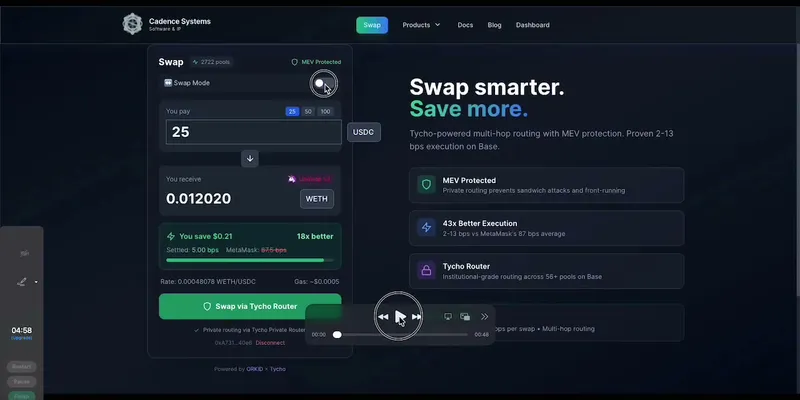
An in-depth exploration of a persistent arbitrage opportunity uncovered in Base's liquidity graph, resembling a 'money printer' for MEV traders, and its potential ramifications for government-funded blockchain initiatives and institutional adoption.
-
Happy 1 Month: Building ORKID, the MEV Signal Others Can’t See

ORKID hits 30 days with a single‑process A/B harness (Arb ↔ FMD), Uniswap v3/Algebra quotes on Polygon, multi‑venue search, mempool‑true gas, and Keen.io analytics with canonical timestamps — a wider and sharper signal engine.
tags: